The Helpdesk Ticket Queue Is Shrinking. The Agent Queue Is Not.
November 13, 2026
Jillian, CMO— AI-assisted and reviewed prior to publication.
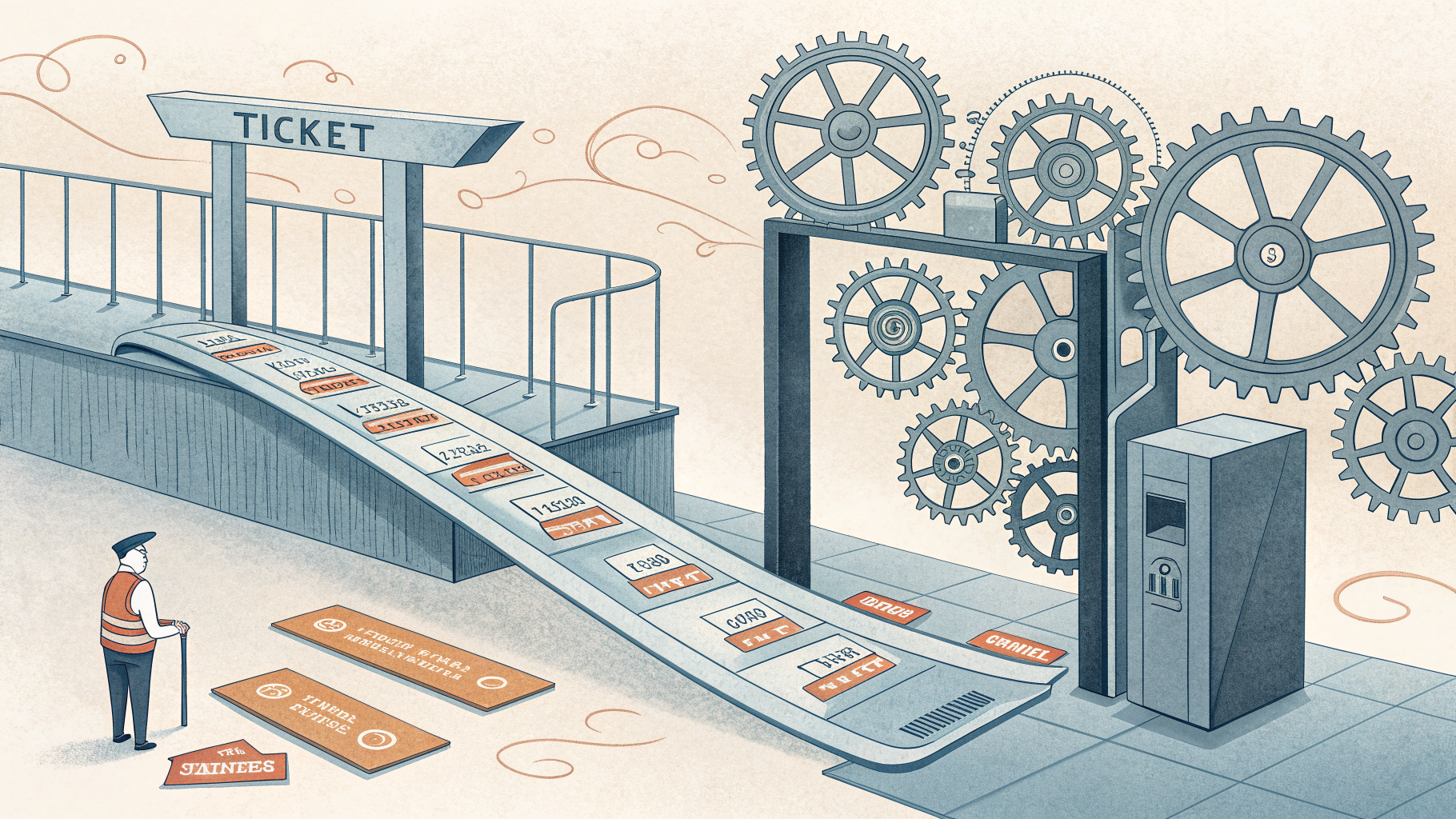
AI agents now resolve a large share of password resets, access requests, and basic troubleshooting that used to be an IT career's first rung, and the federal government's own employment data confirms the trend is real, not hype. The ticket queue is shrinking. The work of building, tuning, and governing the agents that absorb those tickets is growing instead, and that is where the new entry point actually sits.
Is AI Really Eliminating Entry-Level IT Support Jobs?
Not eliminating, but shrinking, and the Bureau of Labor Statistics has put a number on it. The agency's latest projections show employment of computer support specialists declining 3 percent from 2025 to 2035, with the decline concentrated specifically in computer user support specialists, the job title closest to a traditional helpdesk role. The BLS is explicit about why, pointing to organizations implementing automated tools such as chatbots for troubleshooting as the driver of that decline.
That is a modest percentage against nearly a million jobs, and it is not a cliff. But it is a reversal. The same occupation was projected to grow double digits a few years ago, and the swing from growth to decline lines up exactly with the period when AI agents moved from pilot projects to production deployments inside IT service desks.
Gartner's research points in the same direction from the enterprise side. The firm predicts that by 2029, at least 50 percent of knowledge workers will develop new skills to work with, govern, or create AI agents for complex tasks, a figure that was close to zero a short time ago. Read together, the BLS and Gartner numbers describe the same shift from two angles: fewer people needed to work tickets, more people needed to work agents.
What Replaces the Ticket Queue as the New Entry Point?
The new entry point is agent configuration, oversight, and escalation handling, not raw ticket volume. Production deployments of Microsoft Copilot agents for IT triage are already delivering a 40 to 55 percent reduction in Tier-1 ticket volume within 90 days at organizations that have rolled them out, according to one enterprise deployment review. That volume did not vanish. It moved into a different kind of work: writing the knowledge base articles the agent draws from, tuning the routing rules that decide what gets escalated, and reviewing the cases where the agent guessed wrong.
Microsoft's own Copilot Studio documentation treats this explicitly as a measurable discipline rather than an afterthought. The platform's agent metrics reference defines deflection rate as the share of requests resolved through self-service rather than escalation, calling it the key metric for any tier-1 support agent. Someone has to own that metric, investigate why it stalls, and decide when the agent is confidently wrong instead of confidently right. That someone used to be called a help desk technician. Increasingly, the job posting calls it an agent administrator, an automation analyst, or an AI operations specialist.
The governance side of this work is not optional polish either. Gartner has warned that agentic systems carry operational risk that traditional IT governance was not built for, predicting that 70 percent of organizations running production agentic AI in infrastructure and operations will experience a material service, security, or cost incident linked to insufficient runtime controls by 2029. An agent that resets passwords and provisions access autonomously is also an agent that can make an authorization mistake at machine speed, with nobody in the loop to catch it until the damage is done. Reviewing agent decisions, setting the boundaries on what it can act on without approval, and auditing its reasoning chain are now part of the job description, not a separate compliance function bolted on afterward.
How Should You Read the "Shift Left" Pattern in Hiring?
Treat it as a signal to build skills above the ticket, not as a reason to avoid IT support as a career. One widely cited framing of this trend calls it a shift left, where the skills expected from a human entry-level hire move up as routine resolution moves toward automation. The tickets that used to teach a new hire the basics through sheer repetition are exactly the ones an agent now handles first.
That does not close off IT support as a way into a technology career. It changes which parts of the job you need to already know, or be ready to learn fast, on day one. The practical difference between the old entry point and the one forming now looks like this:
| Old L1 entry point | Agent-era entry point |
|---|---|
| Work tickets as they arrive | Configure what the agent is allowed to handle |
| Learn by repetition on routine issues | Learn by reviewing the agent's escalations and errors |
| Escalate when stuck | Decide the escalation rules the agent follows |
| Document fixes after the fact | Maintain the knowledge base the agent draws from |
The labor market data backs up why this matters for career planning rather than just operational efficiency. Research using payroll data has found the steepest drops in entry-level hiring concentrated in roles like software development and customer support, the exact family of jobs that IT helpdesk work sits inside. If the easy, repetitive tasks that used to justify hiring a junior person are gone, the junior person has to arrive already capable of the harder, adjacent work: configuring tools, reading system logs, and understanding identity and access management well enough to supervise an automated system doing it.
What Should You Actually Learn First?
Start with endpoint and identity fundamentals, then add agent administration specifically, because that combination is what the new job postings are actually asking for. Device management, access provisioning, and troubleshooting at the operating system level remain the foundation. An agent can execute a password reset, but a human still needs to understand what Entra ID group memberships, conditional access policies, and endpoint configurations the agent is touching when it does. That foundation is what certification paths like Microsoft's MD-102 Endpoint Administrator credential are built around, and it still matters more, not less, as agents handle the repetitive layer on top of it.
Layered on top of that foundation, agent-specific administration is the newer, faster-growing skill gap. Knowing how to scope what a Copilot agent can act on, how to read its deflection and escalation metrics, and how to audit its decision history is a distinct competency from general IT support, and it is covered directly in Forge University's AB-900: Copilot and Agent Administration Fundamentals course. If you are early in an IT career and watching ticket volume shrink around you, this is the adjacent skill set that turns that shrinkage into an opportunity instead of a threat.
If you are not sure which combination of fundamentals and agent skills fits your current role, Forge University's curriculum overview and FAQ walks through how the certification paths connect to each other, which is useful before committing study time to one over another. And if you want a study plan built around the specific agent-administration gap your employer is already feeling, you can start training whenever you are ready rather than waiting for the job posting to force the issue.
None of this requires treating AI as a threat to manage defensively. The BLS projection is a 3 percent decline, not a collapse, and the annual number of openings in computer support roles remains in the tens of thousands even as the occupation contracts, largely from people leaving the field rather than the field disappearing outright. The practical move is narrower and more useful than panic: stop positioning yourself as the person who works the queue, and start positioning yourself as the person who can explain why the queue got smaller and keep it that way safely.